
Published March 13, 2026
First-Time Homebuyer's Guide to Northern Virginia in 2026


According to the National Association of Realtors, first-time buyers now make up just 21% of all home purchases — a record low — and the typical first-time buyer has reached age 40. That's not a reason to give up. It's a reason to have the right strategy and the right team in your corner.
If you've been thinking about buying your first home in Northern Virginia, you're not alone — and you're not too late. The DMV area remains one of the most desirable places to live in the country, thanks to a strong job market, world-class amenities, and neighborhoods that hold their value. But let's be honest: buying a home in the DMV area comes with its own set of challenges, especially if it's your first time.
Northern Virginia's housing market in 2026 is competitive, but it's also shifting in ways that could work in your favor. Median home prices in the region hover around $755,000, and homes are still moving fast — often selling within a few weeks of hitting the market. Inventory remains tight, and multiple-offer situations are common, particularly in sought-after areas like Arlington, Alexandria, and Fairfax County. For first-time buyers, that can feel overwhelming before you even start.
Here's the good news. Mortgage rates are expected to ease gradually through 2026, with forecasters projecting them to settle near the low 6% range or potentially dip below. Inventory is slowly improving compared to the past few years, and Virginia offers some of the most generous first-time homebuyer assistance programs in the country — many of which go unused simply because buyers don't know they exist. Add it all up, and 2026 is shaping up to be one of the more strategic years in recent memory to make your move.
That's exactly why we put this guide together. At DCI Homes, we help first-time homebuyers in Northern Virginia navigate every step of the process — from understanding what you can afford, to finding the right neighborhood, to making a competitive offer in a fast-moving market. Whether you're eyeing a condo in Arlington, a townhome in Fairfax, or your first single-family home in Loudoun County, this guide will walk you through everything you need to know to buy with confidence in 2026.
What the Northern Virginia Housing Market Looks Like in 2026
Before you start browsing listings, it helps to understand the market you're walking into. Northern Virginia is not a typical housing market — and the numbers tell the story.
The median sold price in Northern Virginia was $675,000 as of January 2026, according to the Northern Virginia Association of Realtors (NVAR). That's actually down 1.5% compared to the same time last year, which marks a notable shift after years of relentless price growth. Active listings climbed 21.1% year over year to 1,526 homes — more than six times the national inventory growth rate. Homes are also sitting a bit longer, averaging 42 days on market in January compared to 31 days the year before.
Translation: buyers finally have a little more breathing room than they've had in years.
That said, this is still a competitive market by any standard. The months of supply in early 2026 sits at roughly 1.1 to 1.2 months — far below the 5 to 6 months that defines a balanced market. Multiple-offer situations still happen, especially in high-demand areas like Arlington, Alexandria, and parts of Fairfax County. If you're looking at Arlington VA real estate in 2026, properties in neighborhoods like Clarendon, Ballston, and Rosslyn still tend to move quickly when they're priced right.
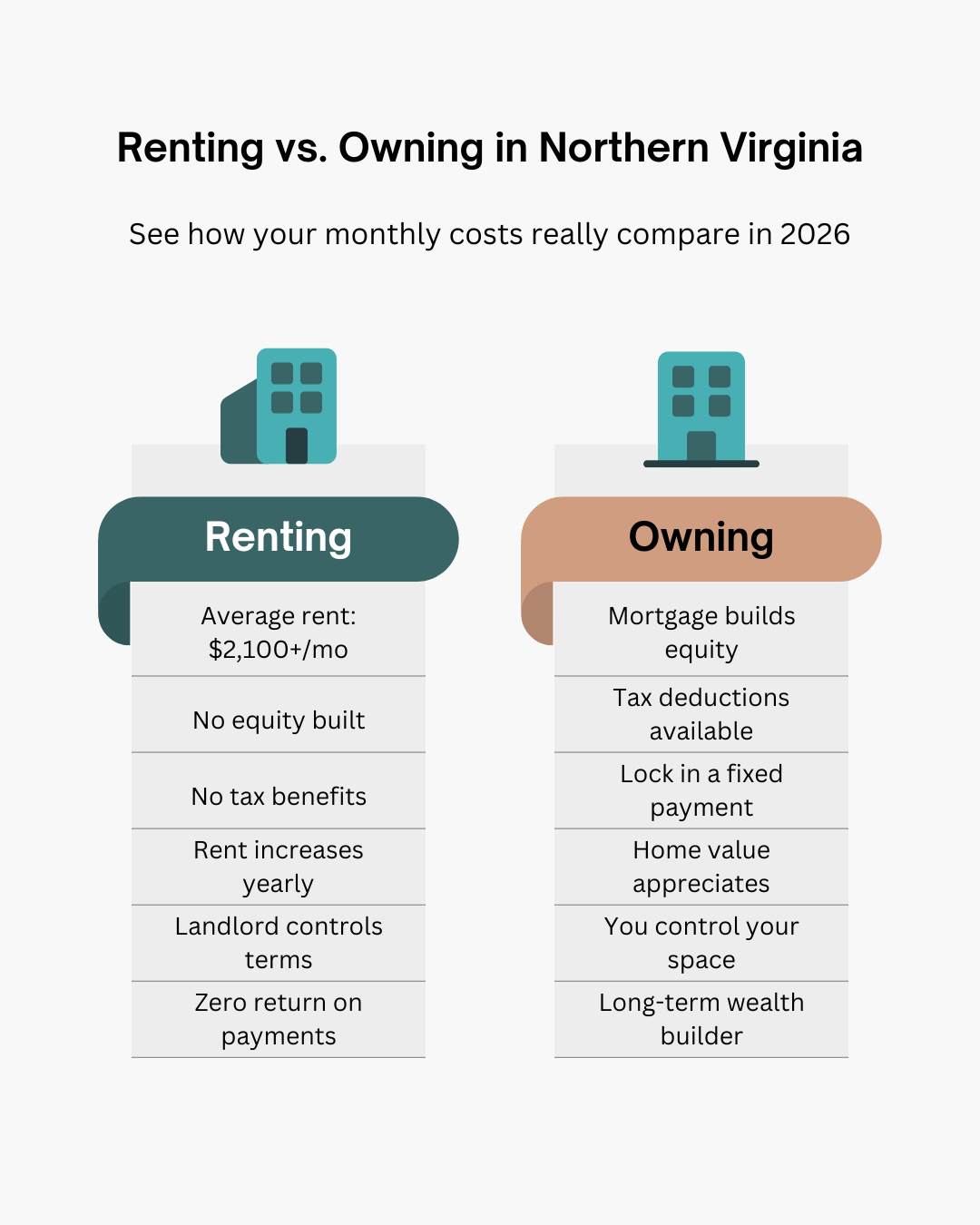
Where mortgage rates are headed
Mortgage rates have been the biggest wildcard for buyers over the past few years, but the outlook for 2026 is cautiously encouraging. Fannie Mae's February 2026 Housing Forecast projects 30-year fixed rates near 6% for most of the year, and the Mortgage Bankers Association expects rates to hold around 6.1% through 2026. As of early March, the average 30-year fixed rate has been hovering right around 6%, which is nearly a full percentage point lower than where rates sat a year ago. That drop may not sound dramatic, but on a $600,000 mortgage, it can mean hundreds of dollars less per month.
The Federal Reserve cut rates three times in 2025 but held steady at its first meeting of 2026. Markets are watching for a potential cut as early as mid-year, which could put additional downward pressure on mortgage rates as the spring and summer buying season heats up.
Why the DMV stays resilient
One thing that makes the Northern Virginia housing market in 2026 different from much of the country is what's driving demand underneath the surface. The DMV economy doesn't depend on any single industry. Federal government employment, defense contracting, a booming tech sector, and strong household incomes create consistent demand for housing regardless of what national headlines say. NVAR's own 2026 forecast notes that the region's strong employment and economic fundamentals continue to support home values, even as the market recalibrates toward healthier balance.
That's also why home prices here haven't dropped the way they have in some Sun Belt markets that overbuilt during the pandemic boom. Northern Virginia is supply-constrained by design — there's only so much land, and demand from a highly educated, high-income workforce isn't going anywhere.
What this means if you're a first-time buyer
Here's the honest picture. The Northern Virginia housing market in 2026 is more favorable for first-time buyers than it has been in at least three years — but it's not easy. Prices remain high, and you'll likely face competition on well-priced properties.
The advantage you have right now is a combination of factors working in your favor at the same time: inventory is growing, rates are near three-year lows, prices have softened slightly, and Virginia offers some of the strongest first-time buyer assistance programs in the country (more on that below). NVAR forecasts single-family home sales to increase 8.4% and inventory to rise 35.8% from 2025 to 2026 — meaning more options and a less frantic pace as the year progresses.
The buyers who do well in this market aren't the ones who wait for the perfect moment. They're the ones who prepare early, understand their numbers, and move with confidence when the right home shows up. That's exactly what the rest of this guide will help you do.
How to Buy Your First Home in Northern Virginia — Step by Step
Knowing the market is important, but knowing the process is what actually gets you into a home. If you're figuring out how to buy a house in Northern Virginia for the first time, these five steps will take you from "thinking about it" to holding your keys.
Step 1 — Check Your Credit and Get Financially Ready
Everything starts here. Before you talk to a lender, browse listings, or fall in love with a kitchen on Zillow, you need a clear picture of where you stand financially.
Your credit score is the single biggest factor in determining what mortgage rate you'll qualify for — and in a market where homes cost $675,000 or more, even a small difference in rate adds up fast. Most lenders require a minimum credit score of 620 for conventional and FHA loans. However, a score of 680 or higher will unlock better rates, lower mortgage insurance costs, and more loan options. If you're eyeing a conventional loan with no private mortgage insurance (PMI), you'll typically need a 660 or above with certain Virginia Housing programs.
Pull your free credit reports at AnnualCreditReport.com several months before you plan to buy. Look for errors, pay down credit card balances, and avoid opening any new lines of credit. These small moves can meaningfully improve your score in a short window.
Next, get familiar with your debt-to-income ratio, or DTI. This is the percentage of your gross monthly income that goes toward debt payments — student loans, car payments, credit cards, and your future mortgage. Most lenders want to see a total DTI of 43% or less, though some loan programs allow up to 50% in certain situations.
A good rule of thumb for budgeting is the 28% rule: your monthly mortgage payment (including principal, interest, taxes, and insurance) should stay at or below 28% of your gross monthly income. In Northern Virginia, where prices are well above the national median, you may need to stretch that number slightly — but running the math before you start looking will keep you grounded and prevent the emotional pull of falling for a home you can't comfortably afford.
Step 2 — Get Pre-Approved for a Mortgage
If there's one first time buyer tip for the DMV that matters more than any other, it's this: get pre-approved before you start your home search. Not pre-qualified — pre-approved. There's a difference.
Pre-qualification gives you a rough estimate based on self-reported information. Pre-approval means a lender has reviewed your income, assets, credit, and debts, and has issued a letter stating exactly how much they're willing to lend you. In a market like Northern Virginia where competitive offers are the norm, sellers and listing agents take pre-approved buyers far more seriously. It signals that you're financially vetted and ready to close.
Getting a mortgage pre-approval in Northern Virginia also helps you understand which loan type fits your situation best. Here's a quick overview of the most common options:
Conventional loans are the most popular choice, offering competitive rates for borrowers with good credit. You can put down as little as 3%, though putting down less than 20% means you'll pay PMI until you build enough equity.
FHA loans are designed for buyers with lower credit scores or smaller down payments. You can qualify with a score as low as 580 and put down just 3.5%. These are popular with first-time buyers, especially younger borrowers — Gen Z uses FHA loans at the highest rate of any generation.
VA loans are available to eligible veterans, active-duty service members, and qualifying spouses. They require zero down payment and no PMI, making them one of the most powerful loan products available. Given the DMV's large military and veteran population, this is a significant option in our area.
USDA loans offer zero-down financing for eligible rural areas. While most of Northern Virginia's urban and suburban core doesn't qualify, some properties in outer Loudoun, Prince William, and Stafford counties may be eligible.
At DCI Homes, we connect our buyers with trusted mortgage partners who specialize in the DMV market and can walk you through which program — or combination of programs — gives you the strongest financial position. Getting pre-approved early isn't just smart preparation; it's the move that puts you ahead of the competition before you ever set foot in an open house.
Step 3 — Define Your Must-Haves and Start Your Search
With your pre-approval in hand and your budget locked in, it's time for the exciting part — finding your home. But before you start scrolling, take a few minutes to define what actually matters to you.
Start with location. In Northern Virginia, your commute, lifestyle, and budget are all shaped by where you choose to live. A condo in Arlington puts you minutes from D.C. but comes with a higher price tag and HOA fees. A townhome in Fairfax gives you more space for the money. Loudoun County offers newer construction and room to grow, with strong schools and expanding transit options. Each area has tradeoffs, and being clear about your priorities will save you weeks of unfocused searching.
Think about what you need versus what you want. Bedrooms, bathrooms, parking, and proximity to Metro or major commute routes are non-negotiables for most buyers. A finished basement, a backyard, or a specific school district might be on your wish list but could require flexibility on price or location.
For first-time buyers in the DMV, condos and townhomes are often the smartest entry point. They're priced lower than single-family detached homes, they're widely available across the region, and they let you start building equity instead of paying rent — even if it's not your forever home. NVAR data shows that condos make up the largest share of available inventory right now, and townhome sales are forecast to increase over 7% in 2026 as more buyers look for affordable options.
Once you know what you're looking for, use tools that actually show you what's available in real time. DCI Homes offers MLS-integrated property search through our website, so you can browse active listings, set up alerts for new properties that match your criteria, and stay ahead of the market without relying on third-party apps that may show outdated information.
Step 4 — Make a Competitive Offer
You've found a home you love. Now you need to win it.
In Northern Virginia, the pace of the market still favors prepared buyers. While homes are sitting slightly longer than they did a year or two ago, well-priced properties in desirable areas can still attract multiple offers within days. Your real estate agent's job is to help you craft an offer that's competitive without overextending your budget.
Here's what goes into a strong offer in 2026. Price matters, but it's not the only factor. Sellers also look at your financing strength (this is where that pre-approval letter does its job), your proposed closing timeline, and any contingencies you include. In some cases, offering flexibility on the closing date or including an escalation clause can make your offer stand out without simply throwing more money at the asking price.
The good news is that 2026's more balanced market gives buyers more room to negotiate than they've had in recent years. Inventory is up, homes are spending more time on market, and sellers are increasingly open to concessions like closing cost credits or repair allowances. Your agent should be helping you read the situation on each individual property and advising you on where you have leverage.
At DCI Homes, our agents know the micro-markets across Northern Virginia — what's moving fast, what's sitting, and where the opportunities are. That local intelligence is the difference between overpaying and getting a smart deal.
Step 5 — Navigate Inspections, Appraisal, and Closing
Your offer has been accepted — congratulations. But there's still work to do between that moment and the day you get your keys. This is the phase where first-time buyers often feel the most overwhelmed, so let's walk through what to expect.
Home inspection. Within a few days of your offer being accepted, you'll schedule a professional home inspection. The inspector will evaluate the property's structure, roof, plumbing, electrical, HVAC, and more. If significant issues come up, you can negotiate repairs with the seller, request a credit toward closing costs, or in some cases, walk away. Don't skip this step — even on newer construction. It's your chance to understand exactly what you're buying.
Appraisal. Your lender will order an independent appraisal to confirm the home's market value supports the loan amount. If the appraisal comes in lower than your offer price, you'll need to negotiate with the seller to lower the price, cover the gap out of pocket, or potentially renegotiate terms. This happens more often than first-time buyers expect, so be prepared for it.
Title search and insurance. A title company will verify that the property has a clear legal title — no liens, disputes, or claims. You'll also purchase title insurance to protect yourself against any issues that might surface after closing.
Final walkthrough. A day or two before closing, you'll walk through the property one last time to confirm it's in the agreed-upon condition and that any negotiated repairs have been completed.
Closing day. This is when you sign the final paperwork, funds are transferred, and the home is officially yours. Bring a government-issued ID, a cashier's check or wire transfer for your closing costs, and be ready for a stack of documents to sign. Your agent and lender will guide you through every line.
The whole process from accepted offer to closing typically takes 30 to 45 days. The biggest first-timer surprises tend to be unexpected costs (like a last-minute HOA transfer fee or prepaid property taxes), delays in document processing, and the emotional rollercoaster of waiting. Having an experienced agent and a responsive lender makes this phase dramatically smoother.
| Step | What to Do | Key Takeaway |
| Step 1 | Check your credit and set your budget | Aim for 620+ credit score, know your DTI, follow the 28% rule |
| Step 2 | Get pre-approved for a mortgage | Pre-approval gives you buying power and credibility with sellers |
| Step 3 | Define your must-haves and start searching | Prioritize location and needs over wants; condos and townhomes are smart entry points |
| Step 4 | Make a competitive offer | Lead with pre-approval, stay flexible on terms, lean on your agent's local expertise |
| Step 5 | Navigate inspections, appraisal, and closing | Budget 30–45 days; don't skip the inspection; prepare for closing costs |
First-Time Homebuyer Programs and Down Payment Assistance in Virginia
For most first-time buyers, the biggest barrier to homeownership isn't the monthly mortgage payment — it's coming up with the cash needed upfront. Between the down payment, closing costs, and moving expenses, you could easily need $30,000 to $50,000 or more before you ever make your first payment on a Northern Virginia home.
The good news? Virginia offers some of the most generous first-time homebuyer programs in the country, and many DMV buyers leave tens of thousands of dollars on the table simply because they don't know these programs exist. If you're exploring down payment assistance in Virginia in 2026, here's what's available to you.
Virginia Housing DPA Grant
Virginia Housing (formerly VHDA) offers a Down Payment Assistance Grant that provides 2% to 2.5% of the home's purchase price as a true grant — meaning you never have to pay it back. On a $500,000 home, that's $10,000 to $12,500 toward your down payment, just for qualifying.
Here's what you need to know:
- The grant covers a significant portion of your minimum down payment, and buyers only need to contribute as little as 1% of the sales price from their own funds or a gift
- It pairs with eligible Virginia Housing first mortgage products, including conventional and FHA loans
- Conventional loans through this program offer reduced mortgage insurance, which lowers your monthly payment
- You must be a first-time homebuyer (no ownership in the past 3 years), meet income and purchase price limits, and complete a free homebuyer education course
- The grant cannot be combined with the Plus Second Mortgage, but it can be combined with other non-Virginia Housing assistance
Virginia Housing Plus Second Mortgage
If you need more down payment help than the grant provides, the Plus Second Mortgage is another option through Virginia Housing. This program pairs a Virginia Housing first mortgage with a second mortgage covering 3% to 5% of the purchase price, which is repaid over 30 years at a fixed rate.
Key details:
- Available to first-time and repeat buyers with credit scores of 680 or higher
- Buyers can finance part of their closing costs in addition to the down payment
- Can bring your out-of-pocket cost at closing close to zero when combined with seller concessions
- Particularly useful for buyers who slightly exceed the DPA Grant's income limits but still need help with upfront costs
Virginia DHCD HOMEownership Program
The Virginia Department of Housing and Community Development runs its own down payment assistance program through the federal HOME program. This one offers more substantial help for lower-income buyers.
- Provides up to 10% of the sales price (up to 15% in certain approved areas), plus up to $2,500 for closing costs, with a maximum of $40,000 in total assistance
- Structured as a deferred, silent second loan — no monthly payments and no interest during the affordability period
- Available to first-time buyers at or below 80% of the area median income
- Requires completion of a HUD-certified homebuyer education course and pre-approval from a licensed Virginia lender
- Assistance is delivered through local DPA providers on a regional basis, so availability may vary by area
Virginia Pilot Down Payment Assistance Program
For buyers with lower incomes, this newer program from DHCD offers even more substantial support — up to $50,000 in assistance for first-time homebuyers with household incomes at or below 60% of the area median income.
- Same deferred loan structure as the HOMEownership program (no monthly payments, no interest)
- Must be purchasing a primary residence and meet standard mortgage underwriting criteria
- Requires a minimum credit score of 620 and completion of a HUD-certified homebuyer education course
- Funding is limited and distributed through local providers, so applying early is important
Mortgage Credit Certificate (MCC)
The MCC isn't a grant or a loan — it's a federal tax credit that saves you money every year you own your home. Virginia Housing issues MCCs to qualifying first-time buyers, allowing you to claim a portion of your annual mortgage interest as a direct tax credit.
- Provides up to 10% of your annual mortgage interest as a tax credit (capped at $2,000 per year) for the life of the loan
- This is a dollar-for-dollar reduction in your federal tax bill — not just a deduction
- Available to first-time buyers (unless purchasing in a targeted area) who meet income limits and use a Virginia Housing-approved lender
- Cannot be combined with the DPA Grant, but works with other Virginia Housing loan products
- Over a 30-year mortgage, an MCC can save you up to $60,000 in taxes
County-Specific Programs in Northern Virginia
Beyond the statewide programs, several Northern Virginia counties offer their own first-time buyer assistance. These are worth researching based on where you're planning to buy:
Fairfax County runs a First-Time Homebuyers Program that offers homes through its Affordable Dwelling Unit (ADU) program at prices well below market rate. Applicants must have at least $25,000 in annual income, a credit score of 620 or higher, and must complete a Virginia Housing homebuyer education course. Homes are allocated through a random selection process.
Loudoun County offers four programs for buyers who have lived or worked in the county for at least six months:
- Down Payment/Closing Cost Assistance (DPCC): up to 10% of the sales price or $70,000 (whichever is less), forgivable over 15 years with no interest
- DPCC Plus: similar structure with additional flexibility for moderate-income buyers
- Public Employee Homeownership Grant (PEG): $25,000 grant for qualifying public employees
- SPARC: a partnership with Virginia Housing that lowers your mortgage interest rate, with $8 million allocated for the program
Alexandria offers access to affordable set-aside homebuyer units, down payment assistance through its Flexible Homeownership Assistance Program, and resale-restricted condos and townhomes at below-market prices. The city regularly markets new affordable units — including recent listings starting under $300,000 — to income-eligible first-time buyers.
Arlington County participates in Virginia Housing's statewide programs and benefits from the SPARC interest rate reduction program. Buyers in Arlington should also explore whether specific developments or community land trusts offer below-market options.
If You're Buying in D.C. — DC Open Doors
DCI Homes serves the entire DMV region, and many of our clients look at homes on both sides of the Potomac. If you're considering purchasing in Washington, D.C., the DC Open Doors program through the D.C. Housing Finance Agency is one of the most accessible programs in the area.
- Provides a deferred, 0% interest loan covering your entire minimum down payment — 3% for conventional loans and 3.5% for FHA loans
- No monthly payments on the assistance loan; you repay only when you sell, refinance, or move out (or after 30 years)
- Open to both first-time and repeat homebuyers
- Income limit is based on borrower income (not household), making it more accessible for dual-income households
- Can be paired with other D.C. programs like the Home Purchase Assistance Program (HPAP), which offers up to $202,000 in additional assistance for lower-income buyers
Homebuyer Education: A Requirement and a Resource
You'll notice a common thread across nearly every program listed above — they all require completion of a homebuyer education course. This isn't just a checkbox. These courses, offered for free through Virginia Housing, HUD-approved agencies, and other providers, cover budgeting, the mortgage process, credit management, and what to expect as a homeowner.
Classes are available both online and in-person, in English and Spanish. If you're serious about buying in 2026, completing your course early is a smart move — it makes you eligible for more programs and gives you a stronger foundation before you start making financial decisions.
Pro tip: Complete your homebuyer education course before you start house-hunting. It qualifies you for assistance programs and gives your lender one less thing to wait on during closing.
Neighborhoods to Know for First-Time Buyers in the DMV
One of the most important decisions you'll make when buying a home in the DMV area isn't just whether to buy — it's where. Northern Virginia, D.C., and the surrounding Maryland suburbs each offer a different mix of affordability, lifestyle, commute options, and long-term value. And for first-time buyers on a budget, some neighborhoods deliver far more value than others.
Here's a neighborhood-by-neighborhood look at the areas worth knowing if you're buying your first home in 2026.
Arlington County
Arlington is one of the most sought-after markets in the entire DMV, and for good reason — it's walkable, well-connected to D.C. by Metro, and home to a strong local economy anchored by Amazon's HQ2, the Pentagon, and a thriving restaurant and retail scene. The median home price in Arlington sits around $700,000 to $760,000 depending on the data source, which puts single-family detached homes out of reach for most first-time buyers.
But here's where it gets interesting for first-timers looking at Arlington VA real estate in 2026. Condos and townhomes tell a very different story:
- High-rise condos in areas like Ballston, Pentagon City, and Columbia Pike commonly sell between $300,000 and $600,000 — a much more accessible range
- Townhome-style units in neighborhoods like Fairlington, Arlington Forest, and Columbia Pike typically range from $550,000 to $620,000
- Condo prices actually declined roughly 7% in 2025, making them one of the more favorable entry points in recent years
Columbia Pike deserves special attention as a value play. Often overshadowed by the more well-known Clarendon and Ballston corridors, Columbia Pike is undergoing significant revitalization with new mixed-use developments, improved streetscaping, and expanding retail. It offers lower price points while still keeping you within minutes of D.C. and the broader Arlington amenity base. For first-time buyers who want an Arlington address without the Clarendon price tag, Columbia Pike is one of the smartest plays in the market right now.
Alexandria
Alexandria offers a blend of historic charm, waterfront living, and walkable neighborhoods that few places in the DMV can match. Old Town Alexandria is iconic but pricey — however, the city has several programs and neighborhoods that make it more accessible than you might think.
What sets Alexandria apart for first-time buyers:
- The city actively markets affordable set-aside condo and townhome units to income-eligible first-time buyers, with recent listings starting under $300,000
- Cardinal Path, a Housing Alexandria project, delivered new two-bedroom townhomes priced at $365,000 and three-bedrooms at $395,000 — well below market rate for the area
- The city's Flexible Homeownership Assistance Program provides additional down payment and closing cost support
- Neighborhoods like Del Ray and the West End offer a more affordable entry compared to the waterfront, with a strong sense of community and walkability to shops, restaurants, and parks
Alexandria also benefits from excellent Metro access (Blue and Yellow lines) and proximity to both D.C. and Arlington, making it a practical choice for commuters.
Fairfax County
Fairfax County is the largest jurisdiction in Northern Virginia and offers the widest range of housing options for first-time buyers — from older townhome communities to newer condos near Metro stations. The county-wide median home price sits around $680,000 to $725,000, but condos average around $380,000 and townhomes around $572,000, which puts them firmly within reach for buyers using assistance programs.
Why Fairfax County works for first-time buyers:
- More space for the money — you'll generally get more square footage in Fairfax than you would in Arlington or Alexandria at the same price
- The county's First-Time Homebuyers Program offers homes through the Affordable Dwelling Unit (ADU) program at prices well below market rate
- Areas like Burke, Centreville, and Herndon offer solid townhome inventory in the $450,000 to $600,000 range with good schools and commuter access
- Proximity to the Silver Line Metro stations in Reston and Tysons has made those corridors increasingly attractive for buyers who work in the tech sector or need direct rail access to D.C.
- Townhome sales in Fairfax County are forecast to increase over 7% in 2026 as buyers look for affordable alternatives to single-family homes
The tradeoff is a longer commute if you work in D.C. proper, but for buyers who work in the Tysons, Reston, or Fairfax City employment corridors, it's a strong fit.
Loudoun County
Loudoun County has been one of the fastest-growing counties in Virginia for over a decade, and it continues to attract first-time buyers looking for newer construction, strong schools, and a suburban lifestyle with room to grow. The county's economy is powered by the data center corridor along Route 7 and the Dulles Toll Road, along with proximity to Dulles International Airport.
What makes Loudoun stand out for first-time buyers:
- Newer housing stock — many developments are less than 15 years old, meaning less maintenance and fewer surprise repair costs
- Some of the strongest local assistance programs in Northern Virginia, including DPCC loans up to $70,000 forgivable over 15 years, and the SPARC interest rate reduction program
- Areas like South Riding, Brambleton, and Ashburn offer townhome communities in the $500,000 to $650,000 range with resort-style amenities
- The Silver Line Metro extension now reaches Ashburn, giving Loudoun residents direct rail access to Tysons, Arlington, and downtown D.C.
- Home prices are generally 10–15% lower than comparable properties in closer-in Fairfax County, while still offering top-rated Loudoun County public schools
The commute to D.C. is the main consideration — even with Metro, you're looking at 45 minutes or more each way. But for buyers who work remotely, have a hybrid schedule, or are employed along the Dulles corridor, Loudoun is hard to beat on value.
Washington, D.C. — Brookland and Congress Heights
DCI Homes serves clients across the entire DMV, and many first-time buyers are surprised to find that D.C. itself has some of the most interesting value opportunities in the region — especially when you factor in the District's generous assistance programs like DC Open Doors and HPAP.
Two neighborhoods in particular are worth watching:
Brookland (Northeast D.C.) has emerged as one of the city's most charming and livable neighborhoods. Known as "Little Rome" for its cluster of historic churches and Catholic institutions, Brookland has a small-town feel with a growing restaurant and retail scene along 12th Street NE. The neighborhood is served by the Red Line Metro (Brookland-CUA station), putting you within 15 minutes of Union Station and downtown. Median prices here climbed about 5% last year, with condos and rowhouses offering entry points well below the District-wide median.
Congress Heights (Southeast D.C., Ward 8) is one of the most affordable neighborhoods in the District, with average sale prices still running roughly 25% below the city-wide median. Ongoing redevelopment projects, including the St. Elizabeths East campus and new mixed-use construction along Martin Luther King Jr. Avenue, are bringing fresh investment to the area. For buyers willing to get in early, Congress Heights offers strong appreciation potential as the neighborhood continues to transform. It's served by the Green Line, with a direct connection to the National Mall and downtown.
A Note on Commute and Metro Access
No matter where you buy in the DMV, your commute will be a major factor in your day-to-day quality of life. Here are a few things to keep in mind:
- Metro access adds value. Homes within a half-mile of a Metro station consistently command premium prices, but they also save you thousands per year in commuting costs compared to driving and parking in D.C.
- The Silver Line extension has changed the map for Northern Virginia, connecting Ashburn and Reston directly to D.C. This has made Loudoun County viable for commuters who previously would have only considered closer-in areas.
- Hybrid work has shifted the math. If you're only commuting two or three days a week, a slightly longer commute in exchange for more space and a lower price may be the right tradeoff.
- VRE (Virginia Railway Express) is another option for buyers looking at Manassas, Woodbridge, or Fredericksburg, offering commuter rail service into D.C.
The best approach is to map your actual commute — at rush hour — before you fall in love with a neighborhood. Your agent should be helping you think through this as part of your search strategy.
| Area | Typical First-Time Buyer Price Range | Best For | Metro Access | Local Assistance Programs |
| Arlington (Columbia Pike) | $300K–$620K (condos/townhomes) | Walkability, nightlife, close-in urban lifestyle | Orange, Blue, Silver lines | Virginia Housing statewide programs, SPARC |
| Alexandria | $280K–$500K (affordable set-aside and condos) | Historic charm, walkability, waterfront access | Blue, Yellow lines | City affordable housing programs, Flexible Homeownership Assistance |
| Fairfax County | $380K–$600K (condos/townhomes) | More space, good schools, suburban convenience | Silver Line (Reston, Tysons) | ADU Program, First-Time Homebuyers Program |
| Loudoun County | $500K–$650K (townhomes/newer construction) | New builds, top schools, room to grow | Silver Line (Ashburn) | DPCC (up to $70K), SPARC, PEG Grant |
| D.C. — Brookland | $400K–$600K (condos/rowhouses) | Charming, walkable, small-town feel in the city | Red Line | DC Open Doors, HPAP (up to $202K) |
| D.C. — Congress Heights | $250K–$450K (condos/townhomes) | Affordability, appreciation potential, investment upside | Green Line | DC Open Doors, HPAP (up to $202K) |
Why Work with a Local Real Estate Expert
You can research neighborhoods online, browse listings on your phone, and even calculate your mortgage payment with a free tool. But when it comes to actually buying a home — especially your first one — in one of the most competitive markets in the country, there's no substitute for having a local expert in your corner.
Northern Virginia isn't one market. It's dozens of micro-markets, each with its own pricing dynamics, inventory patterns, and buyer competition. A condo in Ballston and a townhome in Centreville may both be listed at $500,000, but the strategy required to win each one is completely different. The neighborhoods move at different speeds, sellers in different areas respond to different types of offers, and the factors that drive long-term value vary block by block. A local agent who works these communities daily understands those nuances in a way that no algorithm or national listing site can replicate.
For a first time homebuyer in Northern Virginia, this kind of ground-level knowledge can be the difference between overpaying for a property with hidden problems and landing a well-priced home with real upside.
The DCI Homes Advantage: Real Estate + Construction Under One Roof
This is where DCI Homes brings something to the table that most brokerages simply can't offer. Because DCI operates both a real estate division and a licensed residential construction and remodeling company, our team evaluates properties through two lenses — not just what a home is worth today, but what it could become.
When you tour a home with a DCI agent, you're not just getting a market opinion. You're getting insight from a team that includes licensed realtors, certified designers, skilled contractors, and project managers. That means we can help you:
- Spot renovation potential that other buyers miss. A dated kitchen or an unfinished basement might scare off competing buyers, but our team can estimate what it would cost to transform that space — and whether the investment makes financial sense. That insight can help you find value where others see risk.
- Evaluate a property's true condition. Our construction background means we look at a home's bones, not just its staging. We can flag structural concerns, outdated systems, or deferred maintenance early in the process, so you go into your inspection and offer negotiations with your eyes wide open.
- Keep everything under one roof. If you buy a home that needs work — whether it's a minor cosmetic refresh or a full kitchen remodel — you don't need to spend weeks finding and vetting contractors. DCI's construction division can handle the project from design through execution, with the same team that helped you buy the home in the first place. That kind of continuity saves time, money, and stress.
This dual-service model is especially valuable for first-time buyers who are open to purchasing a home that isn't perfect on day one. In a market where move-in-ready homes command premium prices and attract the fiercest competition, being willing to buy a property with cosmetic or functional issues — and having a trusted partner who can fix them — gives you a genuine competitive edge.
What Does Working with a Buyer's Agent Actually Cost?
One of the most common misconceptions among first-time buyers is that hiring a real estate agent is an added expense. Here's the reality: as a buyer, you typically don't pay your agent's commission directly. The seller pays the commission as part of the transaction, which is then split between the seller's agent and the buyer's agent. This means you get professional representation, local market expertise, negotiation support, and transaction management at no direct out-of-pocket cost to you.
DCI Homes operates under a transparent Buyer Representation Agreement that outlines the terms of our partnership upfront. Our commission structure is typically 2–3%, paid from the seller's side of the closing. No surprises, no hidden fees — just a clear understanding of how we work together from the start.
Your Next Step
If you're a first time homebuyer in Northern Virginia and you're not sure where to start, we've made it easy. DCI Homes offers a free buyer's guide that walks you through the entire process — from getting pre-approved to closing day — with tips specific to the DMV market. It's a great first step, whether you're planning to buy next month or next year.
You can also reach out to our team directly for a no-pressure conversation about your goals, your budget, and what's realistic in today's market. We're based right here in Arlington, and we work with buyers across Northern Virginia, Washington D.C., and Maryland every day.
Frequently Asked Questions
Q: How much do I need for a down payment to buy a home in Northern Virginia?
It depends on your loan type, but you don't need 20% to buy your first home. FHA loans require as little as 3.5% down, conventional loans can go as low as 3%, and VA loans require zero down payment for eligible veterans and service members. On a $500,000 home, a 3.5% down payment would be $17,500 — and Virginia's down payment assistance programs can cover a significant portion of that. The Virginia Housing DPA Grant, for example, provides 2% to 2.5% of the purchase price as a grant that never needs to be repaid, meaning your actual out-of-pocket cost could be as low as 1% of the sales price.
Q: What credit score do I need to buy a house in Virginia?
Most lenders require a minimum credit score of 620 for conventional and FHA loans. However, a score of 680 or higher will give you access to better interest rates, lower mortgage insurance costs, and more loan options — including Virginia Housing's Plus Second Mortgage program. If your score is below 620, some programs may still work for you. The Virginia Pilot Down Payment Assistance Program, for instance, allows exceptions for FHA borrowers with scores as low as 580 if alternative credit can be documented. The best move is to check your credit several months before you plan to buy so you have time to address any issues.
Q: Are there first-time homebuyer programs in Virginia that I don't have to pay back?
Yes. The Virginia Housing DPA Grant is a true grant — not a loan — that provides 2% to 2.5% of your home's purchase price toward your down payment with no repayment required. Virginia Housing also offers a Mortgage Credit Certificate (MCC) that gives you a federal tax credit of up to $2,000 per year for the life of your mortgage, which can add up to $60,000 in savings over a 30-year loan. The Virginia DHCD HOMEownership program is structured as a deferred loan with no monthly payments and no interest during the affordability period, which effectively functions like a grant over time. If you're buying in D.C., the Home Purchase Assistance Program (HPAP) offers up to $202,000 in interest-free, deferred assistance for qualifying buyers.
Q: Is 2026 a good time to buy a home in Northern Virginia?
2026 is shaping up to be one of the more balanced years the Northern Virginia market has seen in a while. Inventory is up over 21% compared to last year, mortgage rates are hovering around 6% (nearly a full point lower than early 2025), and home prices have softened slightly after years of aggressive growth. That combination gives first-time buyers more options, more time to make decisions, and more room to negotiate than they've had since before the pandemic. The market is still competitive — especially for well-priced properties in popular areas — but the frantic pace of bidding wars and waived inspections has largely calmed down. If you're financially ready, waiting for a "perfect" market may cost you more in appreciation than you'd save.
Q: Do I have to pay my real estate agent when buying a home?
No. In most transactions, the seller pays the real estate commissions for both the seller's agent and the buyer's agent as part of the closing costs. This means you get full professional representation — market expertise, negotiation support, access to listings, and guidance through the entire transaction — at no direct cost to you as the buyer. At DCI Homes, we work under a transparent Buyer Representation Agreement that spells out exactly how our partnership works, with a typical commission of 2–3% paid from the seller's side. There are no hidden fees or surprises.